
Carpal Compression Test: What Therapists Should Know
The carpal compression test, also called Durkan’s test, uses sustained pressure over the carpal tunnel to assess whether median nerve symptoms are reproduced. It is one piece of an assessment, with important limitations that should shape how therapists interpret a response.
Written for therapists
Clear explanations to refresh your knowledge and support further learning.
Last Updated
15 October 2026
Related Topics
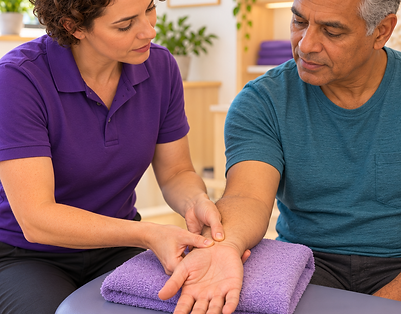
Therapist performing the carpal compression test with thumb pressure over the client’s palm-side wrist, with the forearm supported palm-up on a towel.
What is the carpal compression test?
Durkan described the test in 1991 as a way of provoking symptoms by applying direct pressure over the median nerve at the wrist. Unlike Phalen’s test, its defining feature is external compression rather than sustained wrist flexion. The test is sometimes called the median nerve compression test. (Durkan, 1991.)
The clinical question is whether this brief provocation reproduces a relevant sensory complaint. It does not measure the size of the tunnel or show which tissue is responsible for symptoms. A response also cannot establish whether massage, splinting or another intervention is the best next step.
How is it performed?
Explain the purpose, obtain consent and note any baseline symptoms. Support the forearm with the palm facing upwards and the wrist in a neutral position. Apply steady pressure with the thumbs over the median nerve at the carpal tunnel for up to 30 seconds, asking about symptoms travelling into the hand. Release when the relevant response appears. (Durkan, 1991; Zhang et al., 2020.)
Pressure should be controlled, without escalating it to force a positive finding. Stop if symptoms are distressing or the client asks you to stop. Do not treat a highly irritable presentation as an opportunity to demonstrate every provocative test. Use the assessment within your training and scope, and document any modification or reason it was not completed.
What is a meaningful positive response?
The usual target is numbness or tingling in the median nerve distribution, rather than tenderness from thumb pressure alone. Ask the client to identify the affected fingers and whether the sensation resembles their ordinary symptoms. Record local discomfort separately. Pressure that hurts without reproducing the relevant sensory complaint should not automatically be described as a positive nerve test. (Durkan, 1991.)
If tingling was already present, document whether it changed during testing. “Symptoms reproduced” is potentially misleading when the same symptoms were continuous before contact. Recording the baseline makes the result more useful to another clinician and helps prevent an ambiguous response from appearing more definite than it was.
What does the accuracy research show?
Zhang and colleagues studied 85 hands in 55 people referred with suspected carpal tunnel syndrome. Against electrodiagnostic testing, Durkan’s test had sensitivity of 71% and specificity of 22%. These results apply to that selected clinical sample and should not be treated as universal performance figures. (Zhang et al., 2020.)
In practical terms, a test can reproduce symptoms in some people who do not meet the study’s reference criteria, while missing others who do. A positive finding is therefore not equivalent to a confirmed diagnosis. It is also inappropriate to compare percentages from different studies without considering who was tested and how the tests were performed.
Keep the standard test and its variants separate
Combining wrist flexion with compression creates a different manoeuvre, sometimes called the Phdurkan test. Research results for that combination should not be presented as the accuracy of neutral-wrist compression. Record the method you actually used, including position, duration and symptom response. (Zhang et al., 2020.)
This distinction matters during follow-up. If the position or pressure changes substantially, a different response may reflect the testing method. It should not automatically be interpreted as improvement or deterioration in the nerve. Review the client’s everyday symptoms and function alongside any examination findings.
Turning a finding into a useful clinical decision
Consider a client who reports intermittent symptoms while driving. Reproducing familiar tingling may help connect the examination with their story, but it leaves further questions: how often does this happen, is it worsening, and is hand function changing? Use those questions to guide assessment rather than immediately selecting a local treatment.
The 2024 AAOS guideline supports combining clinical features using the CTS-6. In manual therapy practice, the transferable principle is to integrate history and examination within your competence. Persistent numbness, increasing weakness or visible thenar wasting warrant medical assessment, regardless of whether compression reproduces symptoms on the day. (AAOS, 2024; AAOS, OrthoInfo.)
Clinical Relevance
Clinical example: symptoms appear only when sustained pressure is combined with wrist flexion. Document that modified position rather than calling it a standard carpal compression test. The result may inform your reasoning, but it should be considered alongside the client’s symptom history and function. A provocative assessment is not itself a treatment.
About the publisher
TheTherapyWeb.com provides online professional development for manual therapy practitioners in Australia and New Zealand.
Take your learning further
Carpal Tunnel Syndrome CPE - CPD Professional Development Study Module
Develop your understanding beyond a single provocative test with our Carpal Tunnel Syndrome CPD study module. This knowledge-based online learning option is designed for massage therapists, myotherapists and Bowen therapists.
References
- Durkan JA. (1991). A new diagnostic test for carpal tunnel syndrome. The Journal of Bone and Joint Surgery. American Volume, 73(4), 535–538. https://pubmed.ncbi.nlm.nih.gov/1796937/
- Zhang D, Chruscielski CM, Blazar P, Earp BE. (2020). Accuracy of Provocative Tests for Carpal Tunnel Syndrome. Journal of Hand Surgery Global Online, 2(3), 121–125. https://doi.org/10.1016/j.jhsg.2020.03.002
- American Academy of Orthopaedic Surgeons. (2024). Management of Carpal Tunnel Syndrome: Evidence-Based Clinical Practice Guideline. https://www.aaos.org/cts2cpg
- American Academy of Orthopaedic Surgeons. Carpal Tunnel Syndrome. OrthoInfo. Accessed 15 October 2026. https://www.orthoinfo.org/diseases--conditions/carpal-tunnel-syndrome/
